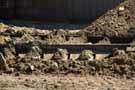
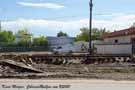
The rails are almost difficult to find in this shot as they are largely buried and well-camouflaged in the still-very-wet mud.
Email Questions or Comments to the Webmaster
or add a comment to the picture.
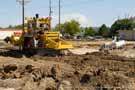
A ballast regulator rests on a portion of the rails that are presently sticking out of the mud. You can see the earth sank a bit (or, perhaps more accurately, was washed away) here as the rails sink down a bit.
Email Questions or Comments to the Webmaster
or add a comment to the picture.
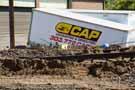
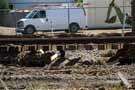
A closeup look at the rail diving down in to the mud left behind from the flood. A lot of digging out will clearly be required to restore the tracks to service.
Email Questions or Comments to the Webmaster
or add a comment to the picture.
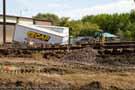
The BNSF Front Range Sub is washed out and covered in thick mud here in Longmont where flood water destroyed a lot. You can see the trailer in the distance, fallen at an angle after the ground beneath partially washed away.
Email Questions or Comments to the Webmaster
or add a comment to the picture.
A look at a stretch of track where the ties are merely dangling from the bottoms of the rails.
Email Questions or Comments to the Webmaster
or add a comment to the picture.
A stretch of tracks probably a quarter of a mile long got rocked by flood waters in Longmont. The track was either completely washed out, or stuck and twisted within thick mud.
Email Questions or Comments to the Webmaster
or add a comment to the picture.
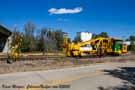
BNSF is totally prepared for the task of getting the tracks ready for trains once again. Here, a tamper sits on the rails, ready to work on the ballast and verify the gauge of the track.
Email Questions or Comments to the Webmaster
or add a comment to the picture.
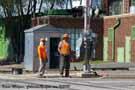
The recent flooding wreaked havoc not only on the tracks, but on wayside equipment too, such as crossing signals. Here, a pair of BNSF workers (or, perhaps, contractors) wait to cross US-287 after working on the electronics in the crossing signal.
Email Questions or Comments to the Webmaster
or add a comment to the picture.
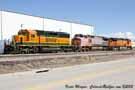
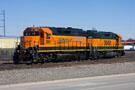
An interesting mix of power, not the least of which is a badly faded Warbonnet, sits near the depot in Longmont.
Email Questions or Comments to the Webmaster
or add a comment to the picture.
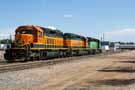
A trio of SD40-2s sit quietly on the west end of the Great Western transfer track in Longmont. Due to the flooding and track damage, these guys likely will be sitting for at least the next few days.
Email Questions or Comments to the Webmaster
or add a comment to the picture.
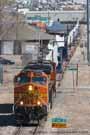
In Longmont, this blade train has made the turn from the south to the west as it crosses US-287 near the Longmont depot. The depot is now used by BNSF as their "headquarters" for locals based out of Longmont.
Email Questions or Comments to the Webmaster
or add a comment to the picture.
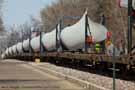
It's amazing how wide these wind mill blades actually are at their base. They are perfect circles at the base. Once attached, the blades will spin at 10-20 revolutions per minute. That can equate to over 200 MPH at the tips. Imagine that centripetal force!
Email Questions or Comments to the Webmaster
or add a comment to the picture.
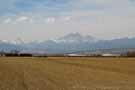
Near Vermillion Road north of Longmont, wind blades pass in front of Longs Peak.
Email Questions or Comments to the Webmaster
or add a comment to the picture.
BNSF 3001, a GP40-2, has been assigned to various locals in Colorado for several years. The graffiti along the conductors side is a relatively recent addition to the New Image scheme. Amazing how little respect some people have.
Email Questions or Comments to the Webmaster
or add a comment to the picture.
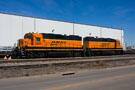
A pair of GP38-2s in matching paint sit on a stub track near the depot in Longmont. This power is used either for the Longmont Turn or the Longmont Switch.
Email Questions or Comments to the Webmaster
or add a comment to the picture.