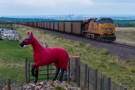
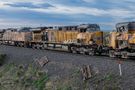
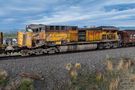
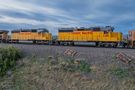
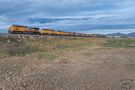
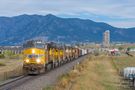
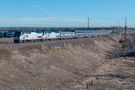
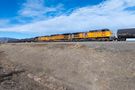
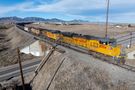
A single ES44AC brings up the end of this eastbound coal load, which just rolled by the "Cold War Horse" statue. It is a life-sized statue of a horse wearing a gas mask and radioactive gear. It showed up here in 2015, about ten years after the cleanup of the Rocky Flat nuclear trigger plant had been completed.
Email Questions or Comments to the Webmaster
or add a comment to the picture.
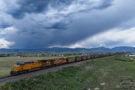
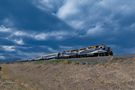
It has been a day of occasional rain and occasional severe thunderstorms. More storm clouds are building over the Rockies as an eastbound UP coal train approaches a green signal at the west end of Leyden.
Email Questions or Comments to the Webmaster
or add a comment to the picture.
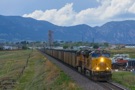
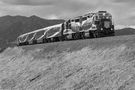
A classic shot of an eastbound UP coal load just west of Leyden. Rumor has it that UP is trying to run 60 coal trains per month on the North Fork Branch out of the West Elk Mine. There has definitely been an increase in the number of coal train on the Moffat in the past few months.
Email Questions or Comments to the Webmaster
or add a comment to the picture.
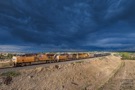
A trio of GEs lead a westbound UP oil train out the west end of Leyden under some crazy storm clouds right around an hour before sunset.
Email Questions or Comments to the Webmaster
or add a comment to the picture.
UP 7198 is one of two units, along with UP 5734 (just to the right) involved in a derailment on the North Fork Branch in December 2025. Union Pacific has finally gotten around to transporting the units east on the MGJNY, just west of Leyden in this shot. It is unclear what the ultimate fate of the units will be.
Email Questions or Comments to the Webmaster
or add a comment to the picture.
That left a mark! On December 3, 2025, UP 5734 was leading a coal empty on the North Fork Branch when the train struck a boulder on the tracks. The crew survived with relatively minor injuries. Not sure if UP 5734 will ultimately survive. It is finally being transported east from Grand Junction, but it is unclear if it will be repaired, or scrapped and written off.
Email Questions or Comments to the Webmaster
or add a comment to the picture.
UP 1997 and UP 1381 are both catching a ride on the MGJNY. They have likely been used as switchers in Grand Junction, and/or on locals that run out of the yard. They are most likely due for 92-day inspections in North Platte.
Email Questions or Comments to the Webmaster
or add a comment to the picture.
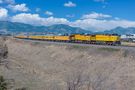
It is not super uncommon for UP's MGJNY to have a lot of units on the head end. However, generally speaking, most are not powered. In fact, of the nine units on the head end of the manifest here, only the lead unit is under power. There is also a single DPU on the tail end. The other eight units are being transported to North Platte (or beyond), for various reasons. The train is just west of Leyden here, under overcast skies.
Email Questions or Comments to the Webmaster
or add a comment to the picture.
Nine units lead the only manifest that Union Pacific still runs on the Moffat. The train passed a green signal at the intermediate at MP 14.6, seen in the distance in this shot. The lead unit, UP 6201, is missing its conductor's number board.
Email Questions or Comments to the Webmaster
or add a comment to the picture.
As the day has progressed, some pretty serious clouds have started to move into the area. Fortunately, breaks to the south allowed for some nice lighting on the Canyon Spirit as it approaches a green signal at the west switch of Leyden. The clouds "bark" was louder than their "bite", as no precipitation was generated this afternoon.
Email Questions or Comments to the Webmaster
or add a comment to the picture.
Other than its departure time, the Canyon Spirit does not follow a super tight schedule when moving to its next destination. At times, the train will run a bit slower to offer riders the opportunity to take in the beauty of the passing landscape. As such, it is always hard to say if the train is early, on time, or late! Such is the case this afternoon. It is 4pm and the train is approaching the west switch of Leyden.
Email Questions or Comments to the Webmaster
or add a comment to the picture.
I think this might be my favorite shot of the day of this Union Pacific passenger special that ran east on the Moffat and then south on the Joint Line. UP deadheaded the train from Grand Junction to Fraser last Sunday. It sat at Fraser until this morning when several VIPs, including UP CEO Jim Vena, boarded the train for a trip to Colorado Springs, CO. In this shot, the train is leaving the Rockies behind as it approaches the west switch of Leyden.
Email Questions or Comments to the Webmaster
or add a comment to the picture.
When the Zephyr departed Chicago yesterday, AMTK 207 was leading the train and AMTK 140 was trailing. Upon arriving in Denver, the position of the units was swapped so that AMTK 140 was leading. I am not sure why Amtrak swapped the units, but it was likely due to some sort of mechanical issue. Consequently, the train is a little over 90 minutes late. The train met an eastbound loaded oil train at Leyden, still visible in the distance.
Email Questions or Comments to the Webmaster
or add a comment to the picture.
BNSF typically runs loaded oil train on the Moffat with three units on the point and three on the end. Union Pacific has opted for three mid-train helper about two thirds of the way through the train. The first DPU, UP 7000, was originally GECX 4000 and was a warranty protection unit, built in 1997. It was subsequently bought by UP and added to the roster as UP 7000.
Email Questions or Comments to the Webmaster
or add a comment to the picture.
UP 8504 is sporting Union Pacific newest paint scheme. This is one of the first SD70ACes I've see with the new scheme. The train is headed for the siding at Leyden to meet a slightly late westbound Zephyr.
Email Questions or Comments to the Webmaster
or add a comment to the picture.