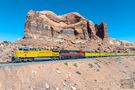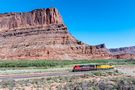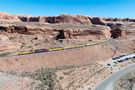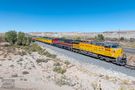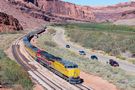
I was hoping that the BNSF oil load that this westbound UP coal load was waiting on would have arrived by now. Alas, it took longer that I had hoped. The coal load would sit in the siding here at Sagers for well over an hour, until after sunset, for the oil train to arrive.
Email Questions or Comments to the Webmaster
or add a comment to the picture.
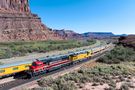
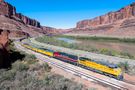
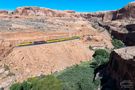
As is the case with several sidings in the desert, UP has installed new signal masts here at West Sagers, but has not yet put the new signal heads on. I am not complaining, though, as I am a sucker for the old Rio Grande signals. A westbound coal load, headed for Intermountain Power in Utah, sits in the siding.
Email Questions or Comments to the Webmaster
or add a comment to the picture.
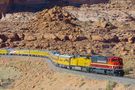
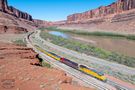
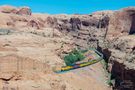
This westbound coal load has taken the siding at Sagers to wait on an eastbound BNSF oil train. A derailment about a week ago at West Solitude still has a 10 MPH slow order out in the desert, delaying all trains that have to run through there.
Email Questions or Comments to the Webmaster
or add a comment to the picture.
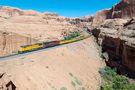
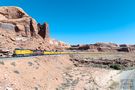
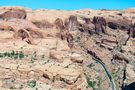
Running with four units (setup 2x2), this westbound coal load is actually moving pretty quick across the Utah desert. The red rocks of Ruby Canyon are visible in the distance. The train is ultimately headed for Intermountain Power in Utah. Intermountain Power is planning to shift away from coal in 2025.
Email Questions or Comments to the Webmaster
or add a comment to the picture.
After running through Ruby Canyon, the tracks start to make a climb up toward a summit at Thompson Hill. You can see the red rocks and the far west end of Ruby Canyon in the distance.
Email Questions or Comments to the Webmaster
or add a comment to the picture.
No trains in this particular shot, but liked the black and white and the desert vibe. UP has erected some new signal masts, but they do not yet have signal heads. Many classic Rio Grande signals are still used here in the desert.
Email Questions or Comments to the Webmaster
or add a comment to the picture.
At the Moab exit off of I-70, exit 182, there is an eccentric gas station known as "Jackass Joe's". It is colorful and covered in stickers. The gas is a bit pricey...$2.00 more per gallon than the Exxon a few miles east in Thompson Springs...but it is quite the little station. The westbound Rocky Mountaineer passes by on the mainline at Brendel.
Email Questions or Comments to the Webmaster
or add a comment to the picture.
After coming up the Cane Creek Subdivision from Seven Mile and running around their train at Thompson, the Rocky Mountaineer is now heading further west than it ever has before. In 2026, the plan is to expand service of the train from Denver to Salt Lake City. This is the a non-revenue test run of the service.
Email Questions or Comments to the Webmaster
or add a comment to the picture.
UP's Potash Local swings away from the Colorado River and toward Bootlegger Canyon so it can reach Moab Tunnel cutting eight miles off the journey cars must travel to reach the same point on the north side. The canyon was cut out for the rails in 1963 when the Cane Creek Sub was originally constructed.
Email Questions or Comments to the Webmaster
or add a comment to the picture.
The engineer on UP's Potash Local gives a friendly wave to several onlookers (out of the frame) in the Corona Arch Trailhead parking lot. The four units on the train are taking 26 loaded covered hoppers back to Grand Junction.
Email Questions or Comments to the Webmaster
or add a comment to the picture.
The look of a spartan cab with UP "Baby Wings" on the nose looks pretty great as the Potash Local slowly makes its way toward Bootlegger Canyon, its switching at Potash complete from the week.
Email Questions or Comments to the Webmaster
or add a comment to the picture.
With its switching at Potash complete, the Potash Local is now headed back to Grand Junction with 26 loaded covered hopper cars in two. The train is paralleling the Colorado River, but will soon turn north into Bootlegger Canyon.
Email Questions or Comments to the Webmaster
or add a comment to the picture.
This pretty much is as definitive "end of track" as you can have! The Cane Creek Subdivision comes to an abrupt end with a huge pile of red rocks and a sudden drop off at the south end of the Potash facility, 37.4 miles south of the mainline at Brendel.
Email Questions or Comments to the Webmaster
or add a comment to the picture.
The Potash Local has hauled the inbound 36 cars as far as they can. They will now cut the two GP40Ns away from the train, tying it down first, and then return to the outbound train at the north end of the facility.
Email Questions or Comments to the Webmaster
or add a comment to the picture.
With the outbound train blocking the opposite track at the north end, the crew of the Potash Local must bring in this string of inbound empties all the way to the south end of the tracks so the two GP40Ns can run light and cross back over to the clear track to the north.
Email Questions or Comments to the Webmaster
or add a comment to the picture.