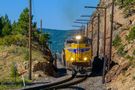
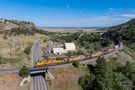
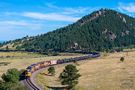
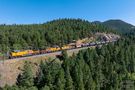
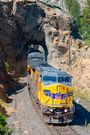
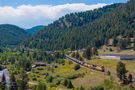
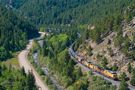
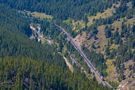
An SD70ACe leads a westbound oil train west out of Crescent toward Tunnel 19. The wires you see to the right and above the train is a slide fence. It held keep rocks off the rails. If a large enough rock breaks through one or more of the wires, it automatically changes the signals protecting the block red and alerts the dispatcher.
Email Questions or Comments to the Webmaster
or add a comment to the picture.
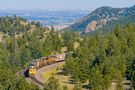
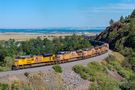
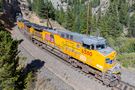
You can peek out onto the plains at the area around Interlocken near the Rocky Mountain Metropolitan Airport as a westbound oil train comes around the curve west of the grade crossing at Crescent.
Email Questions or Comments to the Webmaster
or add a comment to the picture.
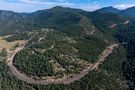
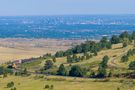
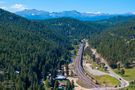
While there is no train in this shot, I thought it was a pretty cool overview of Crescent. It is kind of difficult to tell from the ground that the siding is really built on a (near) 180° curve. In the top-left quadrant of the shot, you can see the west portal of Tunnel 18. Where the tracks disappear on the right side of the shot is Tunnel 19.
Email Questions or Comments to the Webmaster
or add a comment to the picture.
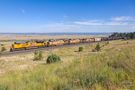
The siding of Plain was originally named Plainview. Rio Grande shortened the names of many of its sidings to save time when talking about them. Plainview was changed to Plain. Pinecliff to Cliff. Rollinsville to Rollins. Plainview's name is very well deserved as you can see out and over the plains of Colorado.
Email Questions or Comments to the Webmaster
or add a comment to the picture.
One of the routes originally explored by David Moffat's team involved going up Coal Creek Canyon. The route would have required a tunnel a couple miles long and the route was originally scrapped in favor of the route we have today. CO-72 now follows much of that route surveyed, crossing underneath the tracks here at the base of Coal Creek Canyon.
Email Questions or Comments to the Webmaster
or add a comment to the picture.
An SD70ACe leads three GEs through the S-Curves at the base of Coal Creek Canyon. The body of water off in the distance is Standley Lake, a main source of drinking water for the Denver suburb of Westminster.
Email Questions or Comments to the Webmaster
or add a comment to the picture.
Wrapping through the S-Curves at Blue Mountain Drive, an empty oil train heads west. It will load at the transload facility in Wash, UT. UP is pretty inconsistent with the power it places on westbound oil trains. This particular one is running with four units on the head end.
Email Questions or Comments to the Webmaster
or add a comment to the picture.
A westbound oil empty comes around the bend from Eisele (Clay) on the approach tot he grade crossing at Blue Mountain. Really like how well the Denver skyline shows up from this perspective. Fortunately, it is a crystal clear day as well.
Email Questions or Comments to the Webmaster
or add a comment to the picture.
Would not mind having the views the owner of the house has near the top of this shot! Among other things, they look down on trains like this oil train, which just knocked down a clear (green) signal at the west end of Crescent.
Email Questions or Comments to the Webmaster
or add a comment to the picture.
Afternoon light in September is perfect for eastbound coming out of Tunnel 29, a trio of AC4400CWs lead a unit oil train east, heading into the Tunnel District.
Email Questions or Comments to the Webmaster
or add a comment to the picture.
UP 6580 leads an eastbound oil train through the shortest tunnel in the Tunnel District, Tunnel 29. It is only 75 feet long. Not entirely sure what happened to the number board on the engineers side of the unit. The blue background is an interesting look!
Email Questions or Comments to the Webmaster
or add a comment to the picture.
An eastbound oil train approaches the grade crossing at Cliff. This time of year, snowpack throughout the Rockies is essentially at its lowest. Save for just a few small patches, the Continental Divide is completely free of snow off in the distance.
Email Questions or Comments to the Webmaster
or add a comment to the picture.
A trio of GEs lead an eastbound loaded oil train out of the valley between Rollins and Tolland. The train is approach a clear (green) signal at Rollins. Indeed, it will only have to briefly stop at Plain for a meet, otherwise making it all the way into Denver.
Email Questions or Comments to the Webmaster
or add a comment to the picture.
The valley between Rollins and Tolland is a somewhat undershot portion of the Moffat, but it has absolutely fantastic scenes if you can find the right perspective. Here, an eastbound loaded oil train, with a trio of AC4400CWs on the point, roll east alongside South Boulder Creek.
Email Questions or Comments to the Webmaster
or add a comment to the picture.
Along South Boulder Creek and Tolland Road, an eastbound loaded oil train slowly descends the grade in the valley between Rollins and Tolland.
Email Questions or Comments to the Webmaster
or add a comment to the picture.