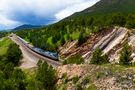
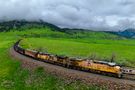
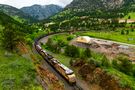
The westbound Zephyr approaches Rainbow Cut halfway through Plain as an early afternoon thunderstorm starts to form over the Rockies in the distance.
Email Questions or Comments to the Webmaster
or add a comment to the picture.
Just west of the grade crossing at Plain, the Zephyr heads west, attempting to make up a bit of time. The train departed Denver Union Station three hours late after departing Chicago nearly three hours late the day before.
Email Questions or Comments to the Webmaster
or add a comment to the picture.
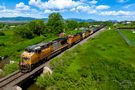
A single BNSF ES44C4 brings up the tail end of an eastbound UP oil train. This ES44C4 is a "Tier 4 Credit" locomotive. After the Tier 4 emissions standards went in to effect, railroads had some carbon credits built up and could use those as credit again Tier 3 locomotives.
Email Questions or Comments to the Webmaster
or add a comment to the picture.
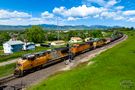
The head end of this eastbound oil train is about to cross Church Ditch on its way east to east of Leyden. The leading unit has fallen victim to some pretty severe tagging (graffiti), suggesting that there is a good chance this unit has spent quite a bit of time in some place like LA or Houston.
Email Questions or Comments to the Webmaster
or add a comment to the picture.
An eastbound UP oil train passes the east switch of Leyden at CP DS012 with a BNSF C44-9W the second spot. That BNSF unit will be cut out in Denver so it can be returned to BNSF.
Email Questions or Comments to the Webmaster
or add a comment to the picture.
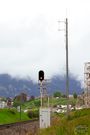
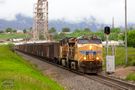
A look at the intermediate signal at MP 14.5 and the large antenna array next to it. The antenna is part of the PTC system in place on the Moffat. PTC stands for Positive Train Control and uses a combination of radio and satellite to ensure better safety for trains on the rails.
Email Questions or Comments to the Webmaster
or add a comment to the picture.
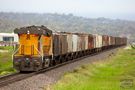
This particular MGJNY was a really interesting one. The train was blocked in to a second of about 25 open hoppers loaded with coal and about 25 covered hoppers at the back. The train was not especially heavy, with two units on the point and a single DPU trailing.
Email Questions or Comments to the Webmaster
or add a comment to the picture.
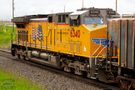
A single DPU bring up the end of this eastbound manifest. This unit is now designated as an C44ACM. It is an AC4400CW that has undergone some rebuilding by UP. This particular unit actually started out life in 1995 as SP 305!
Email Questions or Comments to the Webmaster
or add a comment to the picture.
The weather has been overcast and rainy all day long, which is something of rarity (in general) along the Front Range. However, this has been one of the wettest springs in recorded history in the area! An eastbound manifest, led by a pair of GEs, rolls by, uninhibited by the falling rain and low clouds.
Email Questions or Comments to the Webmaster
or add a comment to the picture.
An eastbound manifest with a long strand of coal hoppers on the head end passes by an Advanced Approach (flashing yellow) signal at MP 14.6. The weather is preventing the dispatcher from getting a signal set up at East Leyden. The train will ultimately have to be flagged past a red signal at East Leyden.
Email Questions or Comments to the Webmaster
or add a comment to the picture.
A top-down look in to one of the open hoppers that serves as a wind break on the inside of Big Ten Curve. As a result of being filled with concrete and dirt, grass and weeds now grow out of the dirt as the hopper serves as a something of a large planter! Meanwhile, on the main, a manifest rolls by heading toward Denver.
Email Questions or Comments to the Webmaster
or add a comment to the picture.
A look into the hoppers that serve as a wind break on the inside of Big Ten Curve (covered in graffiti) as an eastbound manifest with a few dozen car loads of coal pass by on the main.
Email Questions or Comments to the Webmaster
or add a comment to the picture.
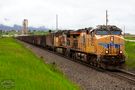
An ES44AC and an AC4400CW lead UP's MGJNY (Manifest, Grand Junction, CO to Denver, CO) out of Eisele (Clay) and around Big Ten. Interestingly, this particular MGJNY is comprised entirely of loaded coal hoppers and covered hoppers! Not sure if the covered hoppers are loaded or empty (or vary).
Email Questions or Comments to the Webmaster
or add a comment to the picture.
The head end of this relatively short MGJNY approaches the hotbox detector at MP 22.6 as a single DPU, facing in to the train, is visible in the distance descending down the grade from Tunnel 1. Note the new construction on the neighhorhood of Canyon Pines.
Email Questions or Comments to the Webmaster
or add a comment to the picture.
At the entry to Coal Creek Canyon, an eastbound coal load crosses CO-72 and wraps around a horseshoe curve to continue the journey east toward Denver.
Email Questions or Comments to the Webmaster
or add a comment to the picture.