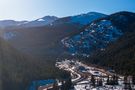
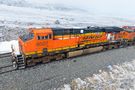
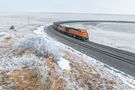
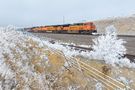
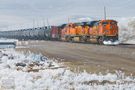
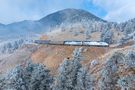
The eastbound Winter Park Express Ski Train just emerged from the Moffat Tunnel and is rolling east on the main. Today, Daylight Saving Time started again for Colorado, adding another hour of light at the end of the day. There is now plenty of light, even when the Ski Train is 45 minutes late.
Email Questions or Comments to the Webmaster
or add a comment to the picture.
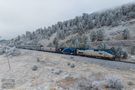
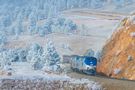
The temperature is 26°F (-3°C) this morning, as the Zephyr leaves Eisele (Clay) and passes through a scene of powdered white frost. The train lost about 45 minutes trying to get to the station in Denver, waiting for the (late) Ski Train to depart. It is now about 1 hour and 15 minutes behind schedule.
Email Questions or Comments to the Webmaster
or add a comment to the picture.
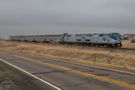
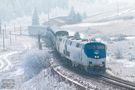
AMTK 11 and AMTK 167 lead the morning Zephyr, running about 1 hour and 15 minutes late, on the main at Eisele (Clay). A fresh bit of frost covers the trees and a bit of the grass.
Email Questions or Comments to the Webmaster
or add a comment to the picture.
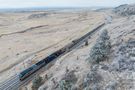
A different perspective on Big Ten from what you might be used to. The westbound Zephyr, sporting a Phase 7 P42DC in the second position, rolls west on the south edge of Big Ten, approaching a clear signal at the east end of Eisele (Clay).
Email Questions or Comments to the Webmaster
or add a comment to the picture.
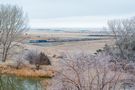
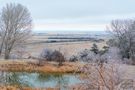
The Zephyr heads west along the south edge of Big Ten Curve as seen from a small retaining pond and several frost trees in the area.
Email Questions or Comments to the Webmaster
or add a comment to the picture.
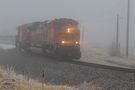
BNSF's Provo-Denver leaves Leyden and approaches the grade crossing at 80th Avenue on a very gloomy, overcast Friday morning. The train met the Ski Train at Rocky and now has a clear shot in to Denver.
Email Questions or Comments to the Webmaster
or add a comment to the picture.
The Winter Park Express (Ski Train) departed from Denver Union Station nearly two hours late this morning. It seems the reason might be due to a mechanical issue with one of the coach Superliners. The train, which had the standard six coaches yesterday, only has five this morning.
Email Questions or Comments to the Webmaster
or add a comment to the picture.
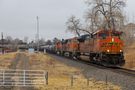
An SD70ACe leads BNSF's daily Provo-Denver east by the hotbox detector at MP 22.6. The train is approaching the grade crossing at Blue Mountain Drive. The train will take the siding at Rocky to meet nearly 2-hour-late Winter Park Express!
Email Questions or Comments to the Webmaster
or add a comment to the picture.
The final DPU on an eastbound oil train shows evidence of the heavy snows the train faced in the Colorado high country on the journey east. Snow is on the front porch, and has actually built up in some of the air intakes along the long hood of the ES44AC.
Email Questions or Comments to the Webmaster
or add a comment to the picture.
BNSF typically runs loaded oil trains on the Moffat in a 3x(0)x3 configuration. However, this particularly load has a somewhat interesting 3x(0)x4 configuration. There are indeed four DPUs on the back end of the train here, tied down in the siding at Rocky. Rime ice brings a muted, powdery effect to the area.
Email Questions or Comments to the Webmaster
or add a comment to the picture.
It's hard to get a shot that feels much colder than this. Despite the relative lack of snow on the ground, the thick rime ice that has formed on the vegetation is bone-chilling. A BNSF oil train sits in the siding at Rocky, tied down and patiently waiting for a fresh crew.
Email Questions or Comments to the Webmaster
or add a comment to the picture.
An eastbound BNSF oil train is tied down in the siding at Rocky, awaiting a crew to come out of Denver to take it the rest of the way in. Plenty of snow from the Colorado high country is built up on the plow of the lead unit.
Email Questions or Comments to the Webmaster
or add a comment to the picture.
This scene has an almost other-worldly quality to it with rime ice stuck to the pine trees and a lot of the vegetation. The reddish dirt and rock stand in stark contrast as the 90 minute late westbound Zephyr approaches the east portal of Tunnel 1. The little bit of fog floating around adds to the curiousness of the morning.
Email Questions or Comments to the Webmaster
or add a comment to the picture.
Rime ice is formed by fog (precipitation in the air) freezing onto vegetation. However, the rime ice typically does not form on rocks and dirt. The result is the ability to tell at a glance what is vegetation and what is not! The red rock face to the right creates a stark contrast to the winter white pine trees to the left as the Zephyr splits to two, climbing toward Tunnel 1.
Email Questions or Comments to the Webmaster
or add a comment to the picture.
A few light snowflakes are falling in this frozen scene as the Zephyr passes by the hotbox detector at MP 22.6, just west of the Blue Mountain grade crossing. When the detector offers up its readout, it will indicate the temperature is a bitter cold 10°F (-12°C) out.
Email Questions or Comments to the Webmaster
or add a comment to the picture.