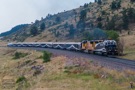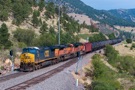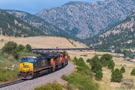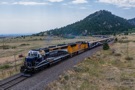
AMTK 130 and AMTK 164 lead the Zephyr west of Tunnel 1. The baggage car is sporting the Phase 3 paint scheme that all the new baggage cars received. However, it has faded quite a bit. More than I would have expected considering how relatively new the baggage cars are.
Email Questions or Comments to the Webmaster
or add a comment to the picture.
One of the first houses to actually start construction in the Canyon Pines development above the tracks at Tunnel 1 is visible in the distance. AMTK 130 is leading the Zephyr into Tunnel 1.
Email Questions or Comments to the Webmaster
or add a comment to the picture.
AMTK 130 and AMTK 164 lead the Zephyr west by Blue Mountain Drive and the hotbox detector at MP 22.6. Rather cool to catch two heritage units on the point of the Zephyr.
Email Questions or Comments to the Webmaster
or add a comment to the picture.
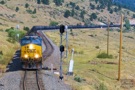
With the 15 MPH slow order behind, the westbound Zephyr is accelerating on the main at Eisele (Clay), just west of the east switch.
Email Questions or Comments to the Webmaster
or add a comment to the picture.
On the north ridge of Big Ten Curve, the California Zephyr is approaching a green signal at the east end of Eisele (Clay).
Email Questions or Comments to the Webmaster
or add a comment to the picture.
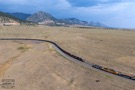
AMTK 130 is leading the Zephyr at 15 MPH on the north edge of Big Ten Curve. Once the train reaches Eisele (Clay) above in the distance, it will be able to accelerate up to track speed.
Email Questions or Comments to the Webmaster
or add a comment to the picture.
This morning, the Zephyr was led by a pair of heritage units, include the Phase 2 unit (AMTK 130) and the Phase 4 unit (AMTK 164). The train is just west of Rocky, starting up on Big Ten Curve.
Email Questions or Comments to the Webmaster
or add a comment to the picture.
The Phase 2 heritage unit has been the most elusive of Amtrak's specially painted units for me to personally get pictures of. The unit seems to have avoided the California Zephyr. I've only seen it a few times since it was unveiled in 2011. This morning, it, along with AMTK 164 (the Phase 4 heritage unit) lead the Zephyr west of Rocky.
Email Questions or Comments to the Webmaster
or add a comment to the picture.
The Zephyr was lucky enough to receive not one, but two heritage units on this westbound run! AMTK 130 (Phase 2) and AMTK 164 (Phase 4) lead the Zephyr by the west end of Rocky, on a 15 MPH slow order (due to heat).
Email Questions or Comments to the Webmaster
or add a comment to the picture.
Just east of Plain, the eastbound Zephyr approaches the west portal of Tunnel 1, prepared to slow down for a 15 MPH heat-related slow order on the opposite side of Tunnel 1. I really like this perspective, but the summer months are often the only time it is possible to shoot the eastbound Zephyr here in daylight. Most of the year, this scene is cast in shadows by the time the Zephyr shows up.
Email Questions or Comments to the Webmaster
or add a comment to the picture.
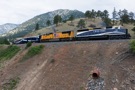
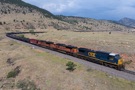
This light power move, which includes ten units, is headed into the siding at the east end of Plain. The units will meet two eastbound here, including a BNSF loaded oil train, and the California Zephyr.
Email Questions or Comments to the Webmaster
or add a comment to the picture.
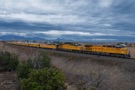
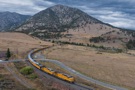
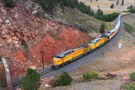
On a beautiful Sunday evening, a westbound light power move is just west of Tunnel 1, headed for the siding at Plain to meet an eastbound BNSF oil train and the eastbound California Zephyr. There are just a few clouds in the sky this afternoon, and the temperature is a toasty 95ºF.
Email Questions or Comments to the Webmaster
or add a comment to the picture.
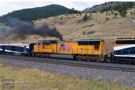
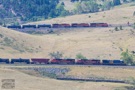
UP 7170 emerges with nine additional units from Tunnel 1. In the distance, you can actually see a small piece of the mainline between the trees, just east of Blue Mountain Drive.
Email Questions or Comments to the Webmaster
or add a comment to the picture.
A ten unit light power move is approaching Blue Mountain Crossing in the distance, as we see the west portal of Tunnel 1 in the foreground. In short order, the power will be emerging from Tunnel 1 as it continues west.
Email Questions or Comments to the Webmaster
or add a comment to the picture.
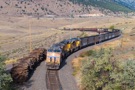
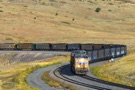
Ten units head west out of Eisele (Clay), likely headed for either Glenwood Springs or Grand Junction, to serve as swing helpers on coal or oil trains.
Email Questions or Comments to the Webmaster
or add a comment to the picture.