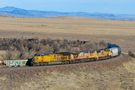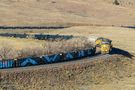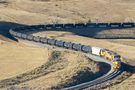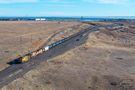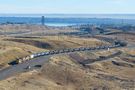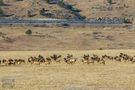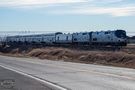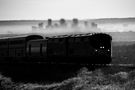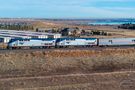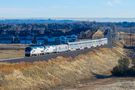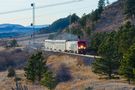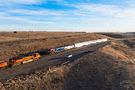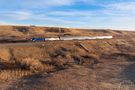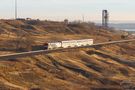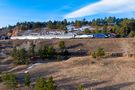
A "standard" Zephyr consist, including a pair of P42DCs, a baggage car, and seven Superliners, is rolling west of Tunnel on the approach to a clear (green) signal at East Plain.
Email Questions or Comments to the Webmaster
or add a comment to the picture.
The morning Zephyr emerges from Tunnel 1 on its journey west, three minutes after being seen in this shot just west of Eisele (Clay) on the other side of CO-72.
Email Questions or Comments to the Webmaster
or add a comment to the picture.
Seven minutes after winding around through Little Ten Curve in this shot, the Zephyr is now continuing west out of Eisele and, approaching the grade crossing at Blue Mountain Drive. In a few minutes, the train will emerge from Tunnel 1 is this shot.
Email Questions or Comments to the Webmaster
or add a comment to the picture.
The Zephyr, running right on time, just knocked down a clear (green) signal at the west end of Eisele (Clay) on its morning journey west.
Email Questions or Comments to the Webmaster
or add a comment to the picture.
Can you spot the Zephyr in this shot? While the camera is setup around MP 23.5, the Zephyr is off in the distance at Rocky and Little Ten Curve, about 3 1/2 (rail) miles east. The train will continue west and the next shot, just west of Eisele, can be seen here.
Email Questions or Comments to the Webmaster
or add a comment to the picture.
The sun is getting much lower in the western sky earlier in the day as we get closer to the end of the summer. Passengers on the eastbound Zephyr enjoy last afternoon views as the train accelerates into Barbara's Gulch.
Email Questions or Comments to the Webmaster
or add a comment to the picture.
In the rays of the setting sun, you can see a little exhaust kicking up on the Zephyr as the train accelerates a bit, approaching the east end of Rocky where speed limits increase. The westbound oil empty on the siding is starting to accelerate as well, the head end already past west Rocky and out on the main.
Email Questions or Comments to the Webmaster
or add a comment to the picture.
With a westbound oil train in the clear in the siding at Rocky, the Zephyr is looking at a clear (green) signal at the west end of Rocky. When Daylight Savings time ends in November, the sun will have set here by the time the eastbound Zephyr arrives, even when it is running right on time.
Email Questions or Comments to the Webmaster
or add a comment to the picture.
The Zephyr is creeping along at 10 MPH due to a slow order around Big Ten Curve. The slow order is in place due to the risk of sun kinks in the rails as a result of hot summer temperatures. Granted, at this point, it is only about 80°F (27°C) out. You can just barely see the east end of Rocky and the start of Barbara's Gulch in the top left portion of the image.
Email Questions or Comments to the Webmaster
or add a comment to the picture.
As the Zephyr rounds Big Ten Curve, you can clearly see the roughly 2% grade of the tracks as they descend down from the mountains. Off in the distance, the buildings consisting of the skyline of downtown Denver stand tall. In an hour, give or take, the Zephyr will be amongst those iron giants for its station stop at Denver Union Station.
Email Questions or Comments to the Webmaster
or add a comment to the picture.
Most of Eisele (Clay) is cast in the shadows of the mountains at 5:45pm this time of year. However, there are a few sections toward the east end that are still lit, and the head end of the Zephyr enters one such section here. Not the westbound UP oil train in the distance at Little Ten Curve.
Email Questions or Comments to the Webmaster
or add a comment to the picture.
A westbound empty oil train, led by an SD70ACe and two ES44ACs pull along the jointed rail of the siding. The house track, which is currently empty, has the derail aligned at the east end. The train will not have long to wait as it is waiting for the eastbound Zephyr. The Zephyr is currently at Plain.
Email Questions or Comments to the Webmaster
or add a comment to the picture.
The signal at the east end of Rocky show a Diverging Approach (red over yellow) signal for an approaching westbound oil train. Note the switch, which is bent for the siding.
Email Questions or Comments to the Webmaster
or add a comment to the picture.
The siding of Plain was originally named Plainview. Rio Grande shortened the names of many of its sidings to save time when talking about them. Plainview was changed to Plain. Pinecliff to Cliff. Rollinsville to Rollins. Plainview's name is very well deserved as you can see out and over the plains of Colorado.
Email Questions or Comments to the Webmaster
or add a comment to the picture.
One of the routes originally explored by David Moffat's team involved going up Coal Creek Canyon. The route would have required a tunnel a couple miles long and the route was originally scrapped in favor of the route we have today. CO-72 now follows much of that route surveyed, crossing underneath the tracks here at the base of Coal Creek Canyon.
Email Questions or Comments to the Webmaster
or add a comment to the picture.